AIRSUPRA is indicated for the as-needed treatment or prevention of bronchoconstriction and to reduce the risk of exacerbations in patients with asthma 18 years of age and older.


FOR ALL ADULT PATIENTS WITH ASTHMA SWITCH TO AIRSUPRA5

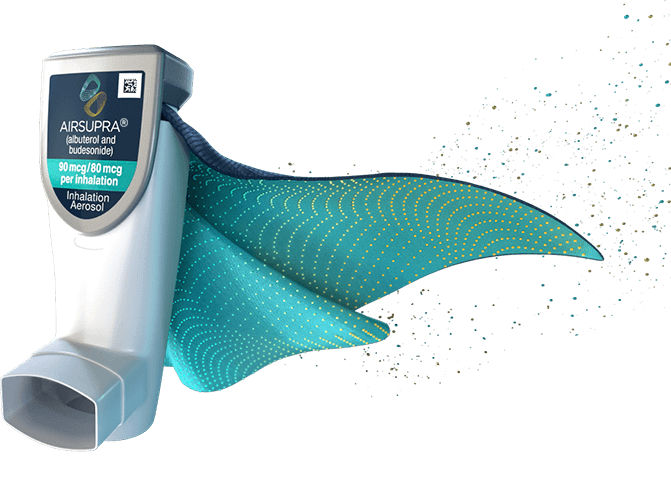
AIRSUPRA is the first and only FDA-approved ANTI-INFLAMMATORY RESCUE that treats bronchoconstriction and helps prevent exacerbations5,6
AIRSUPRA contains albuterol (SABA) for rapid bronchodilation + budesonide (ICS) to address inflammation5
SEE HOW AIRSUPRA IS A DIFFERENT RESCUE
Watch the video in full or select a specific section from the list.
Watch the video in full or select a specific section from the list.
Transcript
Text on screen: REDEFINING THE ROLE OF ASTHMA RESCUE
Graphic on screen: Patient appears on-screen. Camera zooms into the lungs, continuing to a close-up of a bronchiole, followed by the bronchiole constricting and filling with mucus.
Voiceover: Asthma is an inflammatory disease characterized by airway hyperresponsiveness and mucus hypersecretion.
Text on screen: (Graphic labels) BRONCHOCONSTRICTION, INFLAMMATION
Graphic on screen: Camera zooms back out to the patient, who shows difficulty breathing.
Voiceover: Bronchoconstriction and inflammation can lead to increased breakthrough symptoms, including wheezing, chest tightness, coughing, and shortness of breath.
Graphic on screen: Timeline made up of circles animates right to left to take us from 50 years ago into present time.
Text on screen: (footnote) SABA, short-acting β2-agonist.
Voiceover: For nearly 50 years, short-acting beta agonists, or SABAs, have been a standard in asthma rescue.
Graphic on screen: When timeline reaches 2020, guidelines message animates onto screen.
Text on screen: SYMPTOMS & INFLAMMATION
The rescue approach to treating asthma symptoms has changed. The GINA Report and NAEPP guidelines support a rescue approach that treats both symptoms and inflammation.
(footnotes) GINA, Global Initiative for Asthma; NAEPP, National Asthma Education and Prevention Program.
Voiceover: However, the rescue approach to treating asthma symptoms has changed. The GINA Report and NAEPP guidelines support a rescue approach that treats both symptoms and inflammation.
Graphic on screen: Guidelines message animates off-screen and timeline concludes at 2023. As guidelines message fades out, the dots dissolve and animate quickly. Dots form the graphic elements of the logo as product fades in. Camera pulls back to reveal logo on AIRSUPRA inhaler.
Text on screen: (footnote) FDA, Food and Drug Administration.
Voiceover: Finally, there is an FDA-approved anti-inflammatory rescue option for asthma.
Graphic on screen: Inhaler spins as first safety statement appears on screen.
Text on screen: Please see the Important Safety Information for AIRSUPRA at the end of this video.
(footnotes) ICS, inhaled corticosteroid; SABA, short-acting β2-agonist.
Voiceover: AIRSUPRA: the first and only anti-inflammatory rescue containing SABA and ICS designed to treat both symptoms and inflammation.
Graphic on screen: Inhaler fades out as the indication statement comes onto screen.
Text on screen: AIRSUPRA is indicated for the as-needed treatment or prevention of bronchoconstriction and to reduce the risk of exacerbations in patients with asthma 18 years of age and older.
Please see the Important Safety Information for AIRSUPRA at the end of this video.
Voiceover: AIRSUPRA is indicated for the as-needed treatment or prevention of bronchoconstriction and to reduce the risk of exacerbations in patients with asthma 18 years of age and older.
Please see the Important Safety Information for AIRSUPRA at the end of this video.
Graphic on screen: Albuterol and budesonide molecules, connected by a phospholipid, appear on screen.
Text on screen: For illustrative purposes only.
(labels) ALBUTEROL (SABA), BUDESONIDE (ICS), PHOSPHOLIPID
(footnotes) ICS, inhaled corticosteroid; SABA, short-acting β2-agonist.
Voiceover: AIRSUPRA contains albuterol and budesonide in one inhaler.
Graphic on screen: Patient uses inhaler. Teal and gold dots progress from the inhaler, down the airway, and into the lungs.
Text on screen: For illustrative purposes only.
Graphic on screen: Camera zooms into the patient’s lungs, showing the teal and gold dots in the bronchiole.
Text on screen: For illustrative purposes only.
(footnotes) Cyclic AMP, cyclic-3’, 5’-adenosine monophosphate.
Voiceover: SABAs bind to beta2-adrenergic receptors, stimulating a rise in cyclic AMP and activation of protein kinase A, producing airway smooth muscle relaxation.
Graphic on screen: Camera angle shifts to show close-up of bronchiole cross-section.
Text on screen: THE PRECISE MECHANISM OF CORTICOSTEROID ACTION ON INFLAMMATION IN ASTHMA IS NOT KNOWN.
For illustrative purposes only.
Voiceover: Corticosteroids have a wide range of inhibitory activities against multiple cell types and mediators involved in allergic- and nonallergic-mediated inflammation, which may contribute to their efficacy in asthma.
Graphic on screen: Video transitions to the product shot, showing the AIRSUPRA inhaler alongside its box.
Text on screen: THE FIRST AND ONLY FDA-APPROVED ANTI-INFLAMMATORY RESCUE THAT TREATS BRONCHOCONSTRICTION AND HELPS PREVENT EXACERBATIONS
Voiceover: AIRSUPRA: the first and only FDA-approved anti-inflammatory rescue that treats bronchoconstriction and helps prevent exacerbations.
Graphic on screen: Camera cuts away to show the indication statement and scrolling ISI.
Text on screen: AIRSUPRA INDICATION AND IMPORTANT SAFETY INFORMATION
INDICATION
AIRSUPRA is a combination of albuterol, a beta2-adrenergic agonist and budesonide, a corticosteroid, indicated for the as-needed treatment or prevention of bronchoconstriction and to reduce the risk of exacerbations in patients with asthma 18 years of age and older.
IMPORTANT SAFETY INFORMATION
Contraindications: Hypersensitivity to albuterol, budesonide, or to any of the excipients
Deterioration of Asthma: Asthma may deteriorate acutely over a period of hours or chronically over several days or longer. If the patient continues to experience symptoms after using AIRSUPRA or requires more doses of AIRSUPRA than usual, it may be a marker of destabilization of asthma and requires evaluation of the patient and their treatment regimen
Paradoxical Bronchospasm: AIRSUPRA can produce paradoxical bronchospasm, which may be life threatening. Discontinue AIRSUPRA immediately and institute alternative therapy if paradoxical bronchospasm occurs. It should be recognized that paradoxical bronchospasm, when associated with inhaled formulations, frequently occurs with the first use of a new canister
Cardiovascular Effects: AIRSUPRA, like other drugs containing beta2-adrenergic agonists, can produce clinically significant cardiovascular effects in some patients, as measured by pulse rate, blood pressure, and/or other symptoms. If such effects occur, AIRSUPRA may need to be discontinued. In addition, beta-agonists have been reported to produce electrocardiogram (ECG) changes, such as flattening of the T wave, prolongation of the QTc interval, and ST-segment depression. Therefore, AIRSUPRA, like all sympathomimetic amines, should be used with caution in patients with cardiovascular disorders, especially coronary insufficiency, cardiac arrhythmias, and hypertension
Do Not Exceed Recommended Dose: Clinically significant cardiovascular effects and fatalities have been reported in association with excessive use of inhaled sympathomimetic drugs
Hypersensitivity Reactions, Including Anaphylaxis: Can occur after administration of albuterol sulfate and budesonide, components of AIRSUPRA, as demonstrated by cases of anaphylaxis, angioedema, bronchospasm, oropharyngeal edema, rash, and urticaria. Discontinue AIRSUPRA if such reactions occur
Risk of Sympathomimetic Amines with Certain Coexisting Conditions: AIRSUPRA, like all therapies containing sympathomimetic amines, should be used with caution in patients with convulsive disorders, hyperthyroidism, or diabetes mellitus and in patients who are unusually responsive to sympathomimetic amines
Hypokalemia: Beta-adrenergic agonist medicines may produce significant hypokalemia in some patients. The decrease in serum potassium is usually transient, not requiring supplementation
Immunosuppression and Risk of Infections: Due to possible immunosuppression from the use of inhaled corticosteroids (ICS), potential worsening of infections could occur. Use with caution. A more serious or fatal course of chickenpox or measles can occur in susceptible patients
Oropharyngeal Candidiasis: Has occurred in patients treated with ICS agents. Monitor patients periodically. Advise patients to rinse his/her mouth with water, if available, without swallowing after inhalation
Hypercorticism and Adrenal Suppression: May occur with very high doses in susceptible individuals. If such changes occur, consider appropriate therapy
Reduction in Bone Mineral Density: Decreases in bone mineral density have been observed with long-term administration of ICS. For patients at high risk for decreased bone mineral density, assess initially and periodically thereafter
Glaucoma and Cataracts: Have been reported following the long-term administration of ICS, including budesonide, a component of AIRSUPRA
Effects on Growth: Orally inhaled corticosteroids, including budesonide, may cause a reduction in growth velocity when administered to pediatric patients. The safety and effectiveness of AIRSUPRA have not been established in pediatric patients, and AIRSUPRA is not indicated for use in this population
Most common adverse reactions (incidence ≥ 1%) are headache, oral candidiasis, cough, and dysphonia
Drug Interactions: AIRSUPRA should be administered with caution to patients being treated with:
Strong cytochrome P450 3A4 inhibitors (may cause systemic corticosteroid effects)
Short-acting bronchodilators (concomitant use of additional beta-agonists with AIRSUPRA should be used judiciously to prevent beta-agonist overdose)
Beta-blockers (may block pulmonary effects of beta-agonists and produce severe bronchospasm)
Diuretics or non-potassium-sparing diuretics (may potentiate hypokalemia or ECG changes). Consider monitoring potassium levels
Digoxin (may decrease serum digoxin levels). Consider monitoring digoxin levels
Monoamine oxidase inhibitors (MAOI) or tricyclic antidepressants (Use AIRSUPRA with extreme caution; may potentiate effect of albuterol on the cardiovascular system)
Use AIRSUPRA with caution in patients with hepatic impairment, as budesonide systemic exposure may increase. Monitor patients with hepatic disease
Please see full Prescribing Information, including Patient Information.
Voiceover: AIRSUPRA INDICATION AND IMPORTANT SAFETY INFORMATION
INDICATION
AIRSUPRA is a combination of albuterol, a beta2-adrenergic agonist and budesonide, a corticosteroid, indicated for the as-needed treatment or prevention of bronchoconstriction and to reduce the risk of exacerbations in patients with asthma 18 years of age and older.
IMPORTANT SAFETY INFORMATION
Contraindications: Hypersensitivity to albuterol, budesonide, or to any of the excipients
Deterioration of Asthma: Asthma may deteriorate acutely over a period of hours or chronically over several days or longer. If the patient continues to experience symptoms after using AIRSUPRA or requires more doses of AIRSUPRA than usual, it may be a marker of destabilization of asthma and requires evaluation of the patient and their treatment regimen
Paradoxical Bronchospasm: AIRSUPRA can produce paradoxical bronchospasm, which may be life threatening. Discontinue AIRSUPRA immediately and institute alternative therapy if paradoxical bronchospasm occurs. It should be recognized that paradoxical bronchospasm, when associated with inhaled formulations, frequently occurs with the first use of a new canister
Cardiovascular Effects: AIRSUPRA, like other drugs containing beta2-adrenergic agonists, can produce clinically significant cardiovascular effects in some patients, as measured by pulse rate, blood pressure, and/or other symptoms. If such effects occur, AIRSUPRA may need to be discontinued. In addition, beta-agonists have been reported to produce electrocardiogram (ECG) changes, such as flattening of the T wave, prolongation of the QTc interval, and ST-segment depression. Therefore, AIRSUPRA, like all sympathomimetic amines, should be used with caution in patients with cardiovascular disorders, especially coronary insufficiency, cardiac arrhythmias, and hypertension
Do Not Exceed Recommended Dose: Clinically significant cardiovascular effects and fatalities have been reported in association with excessive use of inhaled sympathomimetic drugs
Hypersensitivity Reactions, Including Anaphylaxis: Can occur after administration of albuterol sulfate and budesonide, components of AIRSUPRA, as demonstrated by cases of anaphylaxis, angioedema, bronchospasm, oropharyngeal edema, rash, and urticaria. Discontinue AIRSUPRA if such reactions occur
Risk of Sympathomimetic Amines with Certain Coexisting Conditions: AIRSUPRA, like all therapies containing sympathomimetic amines, should be used with caution in patients with convulsive disorders, hyperthyroidism, or diabetes mellitus and in patients who are unusually responsive to sympathomimetic amines
Hypokalemia: Beta-adrenergic agonist medicines may produce significant hypokalemia in some patients. The decrease in serum potassium is usually transient, not requiring supplementation
Immunosuppression and Risk of Infections: Due to possible immunosuppression from the use of inhaled corticosteroids (ICS), potential worsening of infections could occur. Use with caution. A more serious or fatal course of chickenpox or measles can occur in susceptible patients
Oropharyngeal Candidiasis: Has occurred in patients treated with ICS agents. Monitor patients periodically. Advise patients to rinse his/her mouth with water, if available, without swallowing after inhalation
Hypercorticism and Adrenal Suppression: May occur with very high doses in susceptible individuals. If such changes occur, consider appropriate therapy
Reduction in Bone Mineral Density: Decreases in bone mineral density have been observed with long-term administration of ICS. For patients at high risk for decreased bone mineral density, assess initially and periodically thereafter
Glaucoma and Cataracts: Have been reported following the long-term administration of ICS, including budesonide, a component of AIRSUPRA
Effects on Growth: Orally inhaled corticosteroids, including budesonide, may cause a reduction in growth velocity when administered to pediatric patients. The safety and effectiveness of AIRSUPRA have not been established in pediatric patients, and AIRSUPRA is not indicated for use in this population
Most common adverse reactions (incidence ≥ 1%) are headache, oral candidiasis, cough, and dysphonia
Drug Interactions: AIRSUPRA should be administered with caution to patients being treated with:
Strong cytochrome P450 3A4 inhibitors (may cause systemic corticosteroid effects)
Short-acting bronchodilators (concomitant use of additional beta-agonists with AIRSUPRA should be used judiciously to prevent beta-agonist overdose)
Beta-blockers (may block pulmonary effects of beta-agonists and produce severe bronchospasm)
Diuretics or non-potassium-sparing diuretics (may potentiate hypokalemia or ECG changes). Consider monitoring potassium levels
Digoxin (may decrease serum digoxin levels). Consider monitoring digoxin levels
Monoamine oxidase inhibitors (MAOI) or tricyclic antidepressants (Use AIRSUPRA with extreme caution; may potentiate effect of albuterol on the cardiovascular system)
Use AIRSUPRA with caution in patients with hepatic impairment, as budesonide systemic exposure may increase. Monitor patients with hepatic disease
Please see full Prescribing Information, including Patient Information.
Voiceover: AIRSUPRA Important Safety Information
AIRSUPRA is contraindicated in patients with hypersensitivity to albuterol, budesonide, or any excipients
Asthma may deteriorate acutely or chronically. Continued symptoms after AIRSUPRA or increasing doses of AIRSUPRA may be a marker of asthma destabilization and require evaluation of the patient and their treatment regimen
AIRSUPRA can produce paradoxical bronchospasm, which may be life-threatening. Discontinue AIRSUPRA immediately if paradoxical bronchospasm occurs. Paradoxical bronchospasm frequently occurs with the first use of a new canister of an inhaled formulation
Drugs containing beta 2-adrenergic agonists can produce clinically significant cardiovascular effects in some patients. If these occur, consider discontinuation of AIRSUPRA. Beta-agonists have also been reported to produce ECG changes, such as T wave flattening, QT interval prolongation, and ST-segment depression. Therefore, as with all sympathomimetic amines, AIRSUPRA should be used with caution in patients with cardiovascular disorders, especially coronary insufficiency, cardiac arrhythmias, and hypertension
Do not exceed recommended dose. Clinically significant cardiovascular effects and fatalities have been reported with excessive use of inhaled sympathomimetic drugs
Hypersensitivity reactions, including anaphylaxis can occur after administration of albuterol sulfate and budesonide, as demonstrated by cases of anaphylaxis, angioedema, bronchospasm, oropharyngeal edema, rash, and urticaria. Discontinue AIRSUPRA if these occur
Like all therapies containing sympathomimetic amines, AIRSUPRA should be used with caution in patients with convulsive disorders, hyperthyroidism, or diabetes mellitus, and those unusually responsive to sympathomimetic amines
Beta-adrenergic agonists may produce significant hypokalemia in some patients. Decreased serum potassium is usually transient
Due to possible immunosuppression from the use of ICS, worsening of infections can occur. A more serious or fatal course of chickenpox or measles can occur in susceptible patients
Oropharyngeal candidiasis has occurred in patients treated with ICS agents. Monitor patients periodically. Advise patients to rinse their mouth with water without swallowing after inhalation
Hypercorticism and adrenal suppression may occur with very high doses in susceptible patients. If these occur, consider appropriate therapy
Decreases in bone mineral density have been observed with long-term administration of ICS. Regularly assess patients at high risk for decreased bone mineral density
Glaucoma and cataracts have been reported following long-term administration of ICS, including budesonide
Orally inhaled corticosteroids, including budesonide, may cause a reduction in growth velocity in pediatric patients. The safety and effectiveness of AIRSUPRA have not been established in pediatric patients, and AIRSUPRA is not indicated for use in this population
The most common adverse reactions are headache, oral candidiasis, cough, and dysphonia
AIRSUPRA should be administered with caution to patients being treated with:
Strong cytochrome P450 3A4 inhibitors, which may cause systemic corticosteroid effects
Short-acting bronchodilators (concomitant use of additional beta-agonists with AIRSUPRA should be used judiciously to prevent beta-agonist overdose)
Beta-blockers, which may block pulmonary effects of beta-agonists and produce severe bronchospasm
Diuretics or non-potassium-sparing diuretics, which may potentiate hypokalemia or ECG changes. Consider monitoring potassium levels
Digoxin, which may decrease serum digoxin levels. Consider monitoring digoxin levels
MAOIs or tricyclic antidepressants. Use AIRSUPRA with extreme caution as these may potentiate the effect of albuterol on the cardiovascular system
Use AIRSUPRA with caution in patients with hepatic impairment, as budesonide systemic exposure may increase. Monitor patients with hepatic disease
These are not all of the side effects for AIRSUPRA. Visit www.airsuprahcp.com for additional information, including full Prescribing Information and Patient Information.
Graphic on screen: Reference list appears following ISI.
Text on screen:
REFERENCES:
1. Larsson K, Kankaanranta H, Janson C, et al. Bringing asthma care into the twenty-first century. NPJ Prim Care Respir Med. 2020;30(1):25. doi:10.1038/s41533-020-0182-2.
2. Global Initiative for Asthma. Global Strategy for Asthma Management and Prevention, 2023. Accessed April 21, 2025. Available from www.ginasthma.org.
3. National Asthma Education and Prevention Program. Expert Panel Report 3 (EPR-3): guidelines for the diagnosis and management of asthma-summary report 2007. J Allergy Clin Immunol. 2007;120(suppl 5):S94-S138. doi:10.1016/j.jaci.2007.09.043.
4. Chu EK, Drazen JM. Asthma: one hundred years of treatment and onward. Am J Respir Crit Care Med. 2005;171(11):1202-1208. doi: 10.1164/rccm.200502-257OE.
5. Stein SW, Thiel CG. The history of therapeutic aerosols: a chronological review. J Aerosol Med Pulm Drug Deliv. 2017;30(1):20-41. doi:10.1089/jamp.2016.1297.
6. Cloutier MM, Baptist AP, Blake KV, et al; Expert Panel Working Group of the National Heart, Lung, and Blood Institute (NHLBI) administered and coordinated National Asthma Education and Prevention Program Coordinating Committee (NAEPPCC). 2020 focused updates to the Asthma Management Guidelines: a report from the National Asthma Education and Prevention Program Coordinating Committee Expert Panel Working Group. J Allergy Clin Immunol. 2020;146(6):1217-1270. doi:10.1016/j.jaci.2020.10.003.
7. AIRSUPRA® (albuterol/budesonide) [prescribing information]. Wilmington, DE: AstraZeneca Pharmaceuticals LP; 2023.
8. U.S. Food and Drug Administration. FDA approves drug combination treatment for adults with asthma. Published January 11, 2023. Accessed April 21, 2025. https://www.fda.gov/drugs/news-events-human-drugs/fda-approves-drug-combination-treatment-adults-asthma.
Graphic on screen: Closing frame with AIRSUPRA logo, AstraZeneca logo, and QR code appears on screen.
Text on screen: AIRSUPRA is a registered trademark of the AstraZeneca group of companies. ©2024 AstraZeneca. All rights reserved. US-77470 Last Updated 1/24
www.airsupraHCP.com
FOR ALL ADULT PATIENTS WITH ASTHMA SWITCH TO AIRSUPRA5



IMPORTANT SAFETY INFORMATION
IMPORTANT SAFETY INFORMATION
- Contraindications: Hypersensitivity to albuterol, budesonide, or to any of the excipients
- Deterioration of Asthma: Asthma may deteriorate acutely over a period of hours or chronically over several days or longer. If the patient continues to experience symptoms after using AIRSUPRA or requires more doses of AIRSUPRA than usual, it may be a marker of destabilization of asthma and requires evaluation of the patient and their treatment regimen
- Paradoxical Bronchospasm: AIRSUPRA can produce paradoxical bronchospasm, which may be life threatening. Discontinue AIRSUPRA immediately and institute alternative therapy if paradoxical bronchospasm occurs. It should be recognized that paradoxical bronchospasm, when associated with inhaled formulations, frequently occurs with the first use of a new canister
- Cardiovascular Effects: AIRSUPRA, like other drugs containing beta2-adrenergic agonists, can produce clinically significant cardiovascular effects in some patients, as measured by pulse rate, blood pressure, and/or other symptoms. If such effects occur, AIRSUPRA may need to be discontinued. In addition, beta-agonists have been reported to produce electrocardiogram (ECG) changes, such as flattening of the T wave, prolongation of the QTc interval, and ST-segment depression. Therefore, AIRSUPRA, like all sympathomimetic amines, should be used with caution in patients with cardiovascular disorders, especially coronary insufficiency, cardiac arrhythmias, and hypertension
- Do Not Exceed Recommended Dose: Clinically significant cardiovascular effects and fatalities have been reported in association with excessive use of inhaled sympathomimetic drugs
- Hypersensitivity Reactions, Including Anaphylaxis: Can occur after administration of albuterol sulfate and budesonide, components of AIRSUPRA, as demonstrated by cases of anaphylaxis, angioedema, bronchospasm, oropharyngeal edema, rash, and urticaria. Discontinue AIRSUPRA if such reactions occur
- Risk of Sympathomimetic Amines with Certain Coexisting Conditions: AIRSUPRA, like all therapies containing sympathomimetic amines, should be used with caution in patients with convulsive disorders, hyperthyroidism, or diabetes mellitus and in patients who are unusually responsive to sympathomimetic amines
- Hypokalemia: Beta-adrenergic agonist medicines may produce significant hypokalemia in some patients. The decrease in serum potassium is usually transient, not requiring supplementation
- Immunosuppression and Risk of Infections: Due to possible immunosuppression from the use of inhaled corticosteroids (ICS), potential worsening of infections could occur. Use with caution. A more serious or fatal course of chickenpox or measles can occur in susceptible patients
- Oropharyngeal Candidiasis: Has occurred in patients treated with ICS agents. Monitor patients periodically. Advise patients to rinse his/her mouth with water, if available, without swallowing after inhalation
- Hypercorticism and Adrenal Suppression: May occur with very high doses in susceptible individuals. If such changes occur, consider appropriate therapy
- Reduction in Bone Mineral Density: Decreases in bone mineral density have been observed with long-term administration of ICS. For patients at high risk for decreased bone mineral density, assess initially and periodically thereafter
- Glaucoma and Cataracts: Have been reported following the long-term administration of ICS, including budesonide, a component of AIRSUPRA
- Effects on Growth: Orally inhaled corticosteroids, including budesonide, may cause a reduction in growth velocity when administered to pediatric patients. The safety and effectiveness of AIRSUPRA have not been established in pediatric patients, and AIRSUPRA is not indicated for use in this population
- Most common adverse reactions (incidence ≥ 1%) are headache, oral candidiasis, cough, and dysphonia
- Drug Interactions: AIRSUPRA should be administered with caution to patients being treated with:
- -Strong cytochrome P450 3A4 inhibitors (may cause systemic corticosteroid effects)
- -Short-acting bronchodilators (concomitant use of additional beta-agonists with AIRSUPRA should be used judiciously to prevent beta-agonist overdose)
- -Beta-blockers (may block pulmonary effects of beta-agonists and produce severe bronchospasm)
- -Diuretics or non-potassium-sparing diuretics (may potentiate hypokalemia or ECG changes). Consider monitoring potassium levels
- -Digoxin (may decrease serum digoxin levels). Consider monitoring digoxin levels
- -Monoamine oxidase inhibitors (MAOI) or tricyclic antidepressants (Use AIRSUPRA with extreme caution; may potentiate effect of albuterol on the cardiovascular system)
- Use AIRSUPRA with caution in patients with hepatic impairment, as budesonide systemic exposure may increase. Monitor patients with hepatic disease
INDICATION
AIRSUPRA is a combination of albuterol, a beta2-adrenergic agonist and budesonide, a corticosteroid, indicated for the as-needed treatment or prevention of bronchoconstriction and to reduce the risk of exacerbations in patients with asthma 18 years of age and older.
Please see full Prescribing Information, including Patient Information.
You may report side effects related to AstraZeneca products .
.

Important Safety Information
+
Important Safety Information
ICS, inhaled corticosteroid; SABA, short-acting β2-agonist.
References:
1. Targonski PV, Persky VW, Ramekrishnan V. Effect of environmental molds on risk of death from asthma during the pollen season. J Allergy Clin Immunol. 1995;95(5):955-961. doi:10.1016/s0091-6749(95)70095-1
2. Anderegg WRL, Abatzoglou JT, Anderegg LDL, et al. Anthropogenic climate change is worsening North American pollen seasons. Proc Natl Acad Sci U S A. 2021;118(7):e2013284118. doi:10.1073/pnas.2013284118
3. May L, Carim M, Yadav K. Adult asthma exacerbations and environmental triggers: a retrospective review of ED visits using an electronic medical record. Am J Emerg Med. 2011;29(9):1074-1082. doi:10.1016/j.ajem.2010.06.034
4. Bodaghkhani E, Mahdavian M, MacLellan C, Farrell A, Asghari S. Effects of meteorological factors on hospitalizations in adult patients with asthma: a systematic review. Can Respir J. 2019;2019:3435103. doi:10.1155/2019/3435103
5. AIRSUPRA® (albuterol/budesonide) [prescribing information]. Wilmington, DE: AstraZeneca Pharmaceuticals LP; 2025.
6. US Food and Drug Administration. FDA approves drug combination treatment for adults with asthma. Published January 11, 2023. Accessed February 11, 2026. https://www.fda.gov/drugs/news-events-human-drugs/fda-approves-drug-combination-treatment-adults-asthma

This product information is intended for US Healthcare Professionals only. AIRSUPRA is a registered trademark of the AstraZeneca group of companies.
©2026 AstraZeneca. All rights reserved.
US-99680; US-101262; US-106204; US-107044
Last Updated 3/26
US-99680; US-101262; US-106204; US-107044; US-108137
Last Updated 4/26
US-99680; US-101262; US-108137
Last Updated 4/26
US-99680; US-101262; US-108137
Last Updated 4/26
US-99680; US-101262; US-108137
Last Updated 4/26
US-99680; US-101262; US-108137
Last Updated 4/26
US-99680; US-108137
Last Updated 4/26
US-99680; US-101262; US-108137
Last Updated 4/26
US-99680; US-101262; US-108137
Last Updated 4/26
US-99680
Last Updated 5/25
US-107044; US-108137
Last Updated 4/26
US-108137
Last Updated 4/26
US-99680
Last Updated 5/25
US-99680; US-107044; US-115085; US-117570
Last Updated 10/26
US-107044
Last Updated 3/26
US-99680; US-108137
Last Updated 4/26
